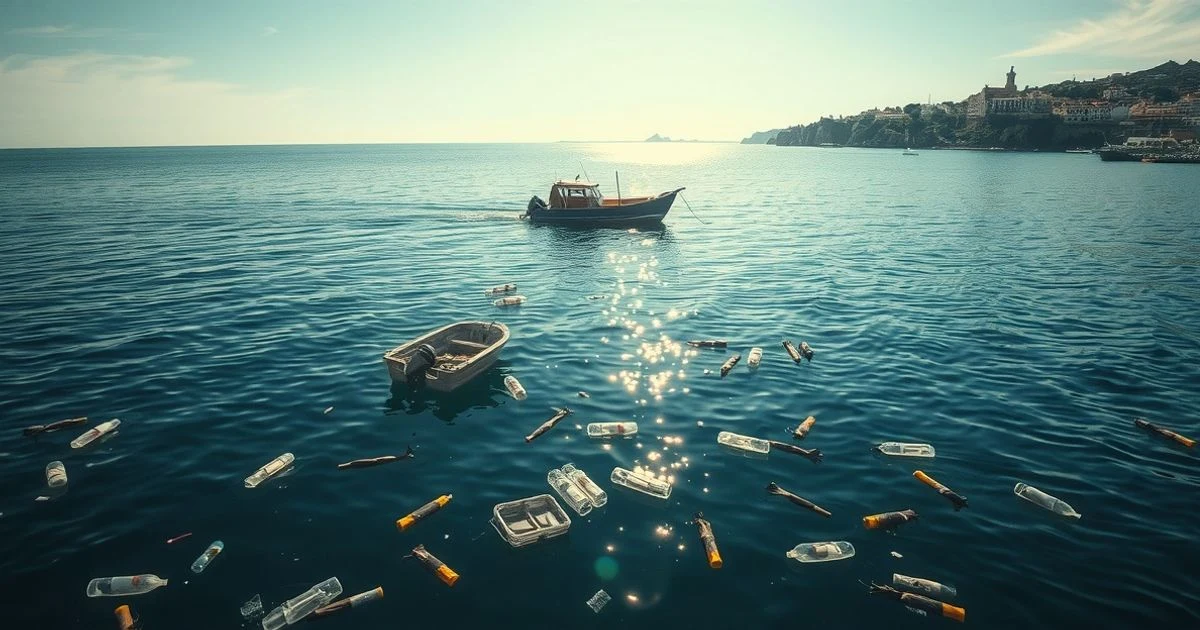
The cleaning boats of the coastline collected 29.26 m³ of waste in June 2026, compared to 33.36 m³ the previous year. Plastic remains the most abundant material, although its actual volume decreased by 11.28%.
The cleaning data for the coastal waters of the Costa del Sol Occidental for June leaves a bittersweet taste. On one hand, the total volume of waste collected has decreased; on the other, plastic remains the unwanted king of the Mediterranean. According to the Association of Municipalities of the Costa del Sol Occidental, in June 2026, 29.26 cubic meters of floating rubbish were removed, compared to 33.36 m³ in the same month of 2025. This represents a drop of 12.3% in total.
Less plastic, but more concentrated
The good news is that the actual amount of plastic extracted from the sea also decreased: from 26.645 m³ in 2025 to 23.639 m³ in 2026, an 11.28% reduction. However, its proportion of the total waste slightly increased, from 79.87% to 80.79%. In other words, although there is less rubbish, the remaining waste is more plastic. Félix Romero, president of the Association, explains cautiously: “This reduction could be related to greater environmental awareness and better waste management, although it may also be due to the fact that the high summer season has not yet begun.”
The president reminded that plastics continue to be the predominant waste, followed by wood, algae, and organic matter. The year-on-year comparison reflects a positive trend, but Romero warns that July and August, with increased tourist influx, will be the real test.
Marbella accumulates the most; Casares, the cleanest
By municipality, Marbella tops the list with 6.40 m³ of waste collected in its waters, closely followed by Estepona (6.27 m³). On the opposite side, Casares recorded only 0.29 m³ and Manilva 1.16 m³. The rest of the localities fall within intermediate figures: Torremolinos (3.04 m³), Benalmádena (4.56 m³), Fuengirola (3.02 m³), and Mijas (4.52 m³).
For the average swimmer, this data translates into a more pleasant experience: fewer floating bags and less plastic on the shore. But the work does not end here. The Association insists that citizen awareness is key, especially during the summer months when human pressure on the coastline multiplies.
In short, the Costa del Sol is moving towards cleaner waters, although plastic remains a tough nut to crack. The coming months will reveal whether the trend consolidates or if summer brings a new wave of waste.

You may also like