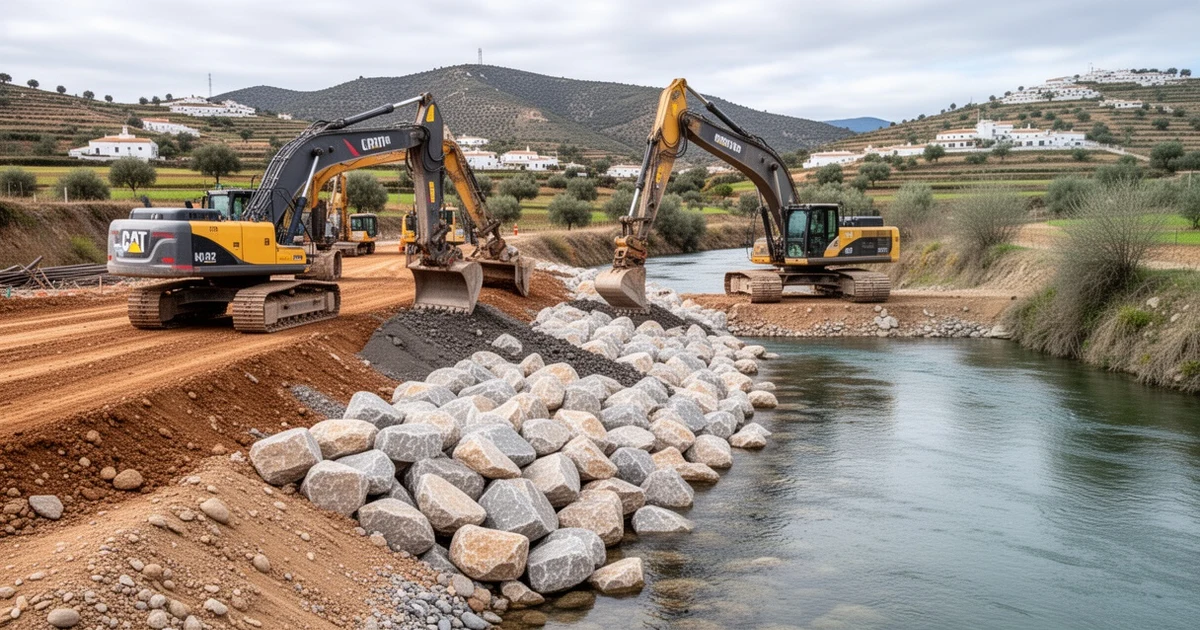
The Junta de Andalucía invests more than €655,000 in stone riprap works to channel the Guadalhorce river in Villanueva del Trabuco, part of the Plan Actúa. The project aims to reduce flood risk after decades of local demands.
The regional government of Andalusia has begun construction of a stone barrier along the Guadalhorce river in the municipality of Villanueva del Trabuco, with an initial investment exceeding €655,000. The works, which form part of the broader Plan Actúa, are designed to prevent the river from overflowing during heavy rainfall, a recurring threat that has worried residents for generations.
The project covers a stretch from Puente San Antonio to the Junta de los Tres Ríos, where the river has historically broken its banks. Workers are placing large riprap stones to reinforce the banks and direct the flow, a technique that has proven effective in similar interventions across the province. The investment may increase as work progresses, depending on unforeseen needs, the local council stated.
On Thursday, the territorial delegate for Agriculture, Fisheries, Water and Rural Development in Málaga, Fernando Fernández, visited the site to oversee the project's progress. He was accompanied by municipal officials, river guards, technicians, and contractors. During the visit, Fernández signed the town's Book of Honors and Distinctions, leaving a dedicatory note.
“We are facing a historic action for our municipality. A long-standing neighborhood demand that will mean a significant improvement in safety for all residents of Villanueva del Trabuco, helping to minimize the risks of river overflow during torrential rain episodes,” the city council said in a statement.
The project has been awaited for decades. Residents have repeatedly called for measures to protect homes and farmland from the Guadalhorce's seasonal floods. In 2018, heavy rains caused significant damage in the area, highlighting the need for structural defenses. The current intervention is part of a larger effort by the Andalusian government to address flood risks in the region's river basins.
The stone riprap is expected to provide a durable solution, as it resists erosion and can adapt to the river's dynamics. Similar works have been carried out in other municipalities along the Guadalhorce, such as in Álora and Pizarra, where they have reduced flood damage. The investment of €655,000 covers the first phase, with potential additional funds for further reinforcement if necessary.
The visit by Fernández included a review of the technical aspects of the construction. The delegate emphasized the collaboration between regional and local authorities in executing the Plan Actúa, which aims to improve water management and prevent disasters across Andalusia. He stressed that the work is being carried out with minimal environmental impact, using locally sourced stone and respecting the river's ecosystem.
For the residents of Villanueva del Trabuco, the project brings peace of mind. “We feel safer now that we see the machines working,” said a local farmer who preferred not to be named. “Every autumn we feared the river would flood our fields. This should end that.” The council has assured that the works will not disrupt daily life significantly, although some detours may be necessary near the bridge.
The project is expected to continue for several weeks, depending on weather conditions. Once completed, the reinforced banks will be monitored regularly by the regional water agency. The local government has pledged to maintain the structure and carry out periodic inspections to ensure its effectiveness.
This is not the only water-related investment in the area. The Junta has also allocated funds for cleaning and dredging other sections of the Guadalhorce basin. The Plan Actúa includes a comprehensive strategy for flood prevention, with a budget of over €100 million for the entire region. Villanueva del Trabuco's project is one of several aimed at protecting communities along the river.
In the long term, the channeling works will also improve irrigation for local agriculture, as controlled water flow benefits crops. The municipality, known for its olive groves and wheat fields, relies heavily on the river for farming. The new infrastructure is expected to support sustainable agriculture while reducing disaster risks.

You may also like