Estepona City Council has completed the comprehensive renovation of the Municipal Archaeological Museum, which involved an investment of €97,999 (including VAT) and allows for the exhibition space to be doubled. The work includes a new room on the upper floor, a lift, and the restoration of the façade.
The comprehensive renovation of the Municipal Archaeological Museum of Estepona has reached its conclusion. The City Council has invested €97,999 (including VAT) in work that has doubled the exhibition space and will allow for the unveiling of dozens of archaeological pieces that have remained stored due to lack of space.
The Councillor for Heritage and Museums, Daniel García Ramos, explained that the bulk of the work focused on the construction of a new large room on the upper floor, where an old beamed ceiling typical of 18th-century local constructions has been restored. This ceiling has received specific treatment to preserve it in optimal conditions.
On the same floor, the security of the upper gallery has been reinforced. The walls of the balcony have been raised with glass panels, a solution that protects visitors without detracting from the spaciousness or visibility of the area, located above the ground floor.
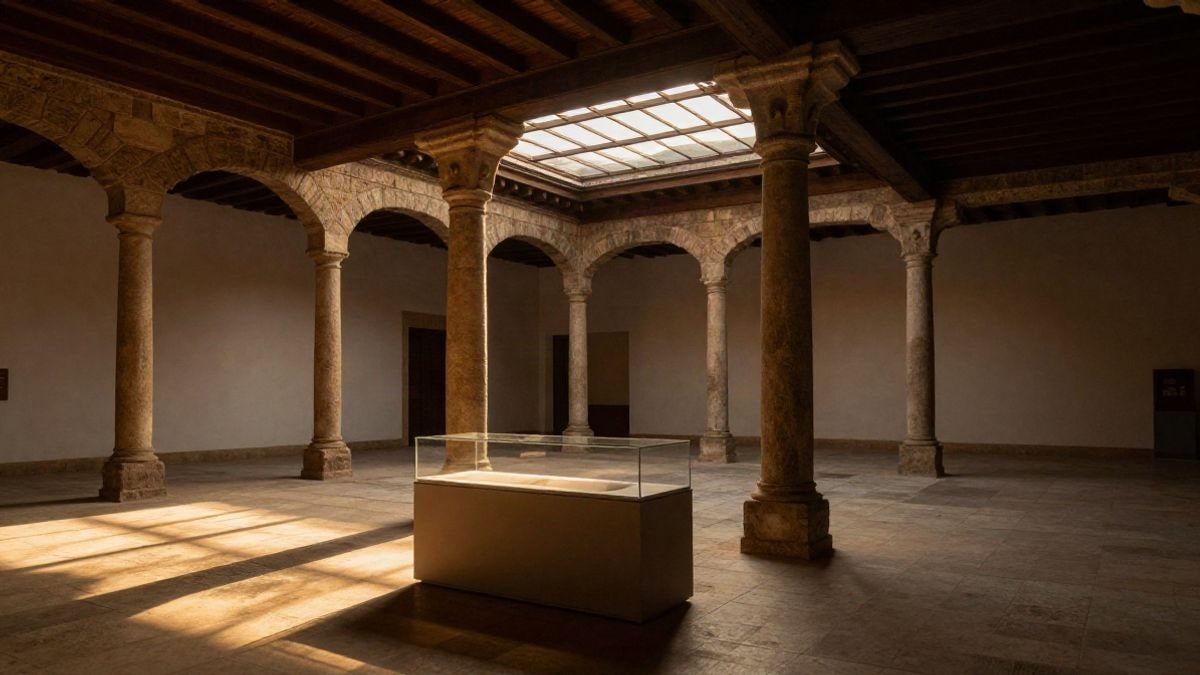
The ground floor has also changed. A lift has been installed and the restrooms have been renovated. In the central courtyard, which remains at the same level, the flooring has been renewed and the fountain has been removed. An artistic stained glass window has been placed over this space, serving as a cover.
The columns on both floors have been restored to recover their original state as much as possible, the interior lighting has been renewed, and rooms 1, 2, 3, and 4 have been rearranged, with renovated display cases. The cistern has been left with its access opening visible and will be covered with structural glass. The balustrade of the staircase and the steps have also been renewed, replacing broken pieces and restoring the formation of the steps.
The councillor noted that there are small finishing touches remaining: painting, cleaning, installation of new furniture, and the display cases that will house the pieces. In parallel, the entire façade is being restored.
“The archaeological work of recent years has uncovered dozens of pieces that speak of the origins of the city of Estepona, and it was necessary to provide the museum with more rooms to display them,” García Ramos indicated.
Most of these remains date from prehistoric, Roman, and Islamic periods, and only a small part has been able to be exhibited so far in a temporary display. The aim of the municipal project is for these collections to have a permanent space within the museum.
The building housing the museum dates back to the 18th century and has a ground and upper floor, organized around a central courtyard where a cistern belonging to a Muslim-era tower is located. On both floors, there is a porticoed gallery around the courtyard that distributes access to the different rooms.
With the finishing touches pending, the opening to the public of the new room and the display cases will depend on the installation of the furniture and the placement of the archaeological pieces, which does not yet have an official date.

You may also like