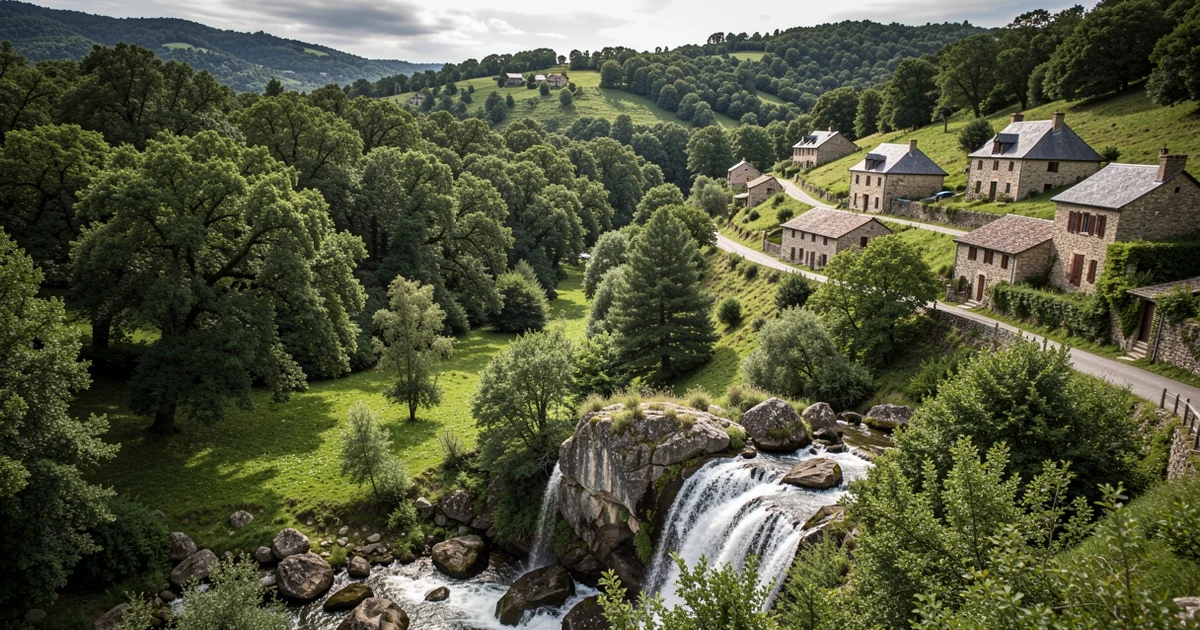
Viajar magazine has described Las Hurdes as the Spanish Black Forest. The Cáceres region, with six municipalities and over 40 hamlets, offers forests, waterfalls, and slate architecture.
To the north of the province of Cáceres, very close to the border with Salamanca, lies a region that completely breaks with the image that most people have of Extremadura. Instead of the dehesa, the plains, and the dry heat usually associated with the region, Las Hurdes offers deep valleys, oak and chestnut forests, crystal-clear gorges, and a green that surprises those who arrive for the first time.
It is precisely this exuberance that has led Viajar magazine to describe it as the Spanish Black Forest, a comparison that aptly summarises the contrast between what is expected of this land and what is actually found there.
Six municipalities and over 40 hamlets scattered among deep valleys
The region is made up of six municipalities (Caminomorisco, Casar de Palomero, Ladrillar, Nuñomoral, Pinofranqueado, and Casares de las Hurdes), but its true essence is spread among the more than 40 hamlets that depend on them. These are small population centres scattered across hillsides and valleys that can only be reached via narrow, winding roads.
This historical isolation, which for decades was a source of stigma for the area, has today become its main tourist attraction, as it preserves an authenticity that is increasingly hard to find in other rural destinations in Spain.
The natural landscape is undoubtedly the main draw of Las Hurdes. The Melero Meander, with its views over the Alagón River from the Antigua viewpoint, is the most recognisable image of the region, but it is not the only must-see stop. The Meancera Waterfall, which shows its greatest flow in spring, or the Chorrituero de Ovejuela, which can be reached after an easy hiking route, complete a tour of waterfalls and gorges that rivals other landscapes in northern Spain or Europe.
Slate architecture and a past that is being reclaimed
The traditional slate architecture is another hallmark of the area, particularly visible in hamlets like El Gasco, Riomalo de Arriba, or Casares de las Hurdes, considered some of the most photogenic in the region. In El Gasco, meanders and terraces coexist with a very particular point of interest: the area popularly known as 'the volcano', a place where a meteorite is believed to have fallen and which forms part of the scientific interest of this Cáceres corner.
The region has been leaving behind the shadow cast by the documentary 'Las Hurdes, tierra sin pan', which Luis Buñuel filmed in 1933 and which for decades associated this land with extreme poverty and isolation. Since the 1990s, with the boost of rural tourism, Las Hurdes has been transforming that image into a destination that champions its traditional culture, its gastronomy, and a natural environment that many still do not know, despite being a short distance from cities like Cáceres or Salamanca.
This reclamation is also reflected in current initiatives such as 'Primavera de Leyenda en Las Hurdes', a programme promoted by the Cáceres Provincial Council and the Las Hurdes Tourism Association (Athur) that traverses various hamlets with hiking routes, organic markets, tastings of local products, and activities linked to the legends and traditions of the region.
For the traveller seeking something different, Las Hurdes offers an experience that combines nature, history, and authenticity. However, it is advisable to be prepared for narrow roads and a leisurely pace: there are no rushes here, and time is measured in steps through the forest and the sound of water falling among the rocks.

You may also like