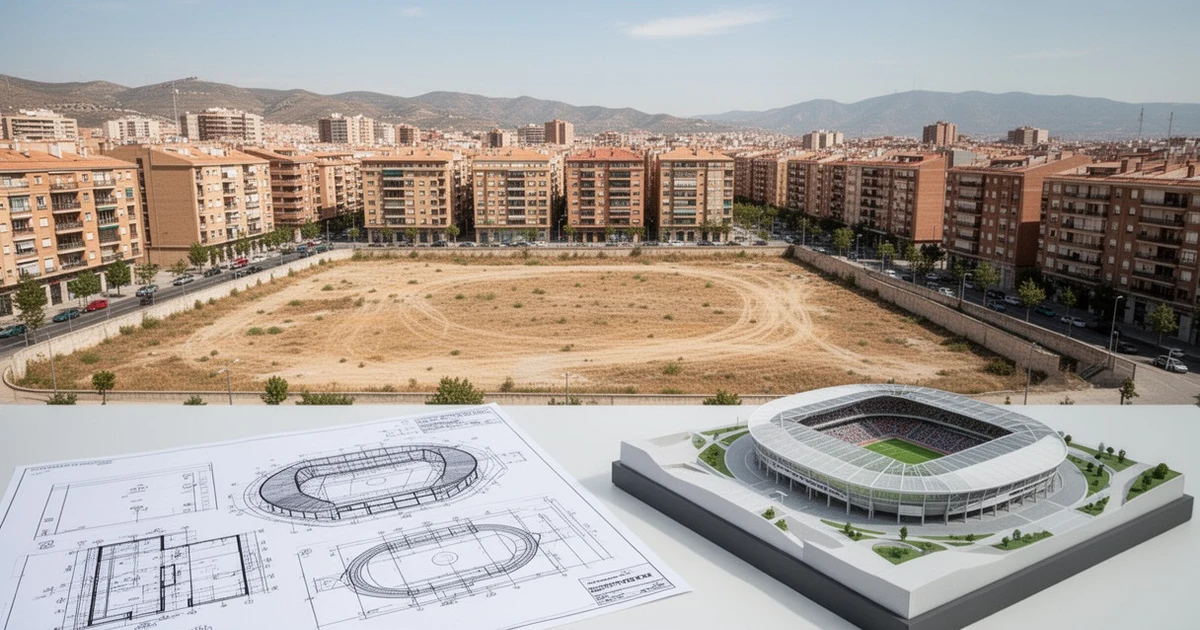
The Málaga City Council has approved the location for the new Nueva Rosaleda stadium after a comprehensive study of alternatives, marking a major step for the city's sports infrastructure.
The Málaga City Council officially presented the feasibility study for the new stadium, known as Nueva Rosaleda, on Wednesday, detailing the criteria that led to the selection of the final site. The document, unveiled at municipal offices, evaluates multiple strategic locations based on accessibility, technical viability, urban impact, and economic implications.
According to the technical report, the chosen site offers the best balance of integration into the urban fabric and long-term sustainability. The new venue is expected to replace the current La Rosaleda stadium, which has served as the home of Málaga CF since its inauguration in 1941. The current facility, with a capacity of just over 30,000, has faced criticism for its aging infrastructure and limited modern amenities.
The study examined several potential zones across the city, including areas near the port, the Guadalhorce industrial estate, and land adjacent to the Málaga-María Zambrano train station. The selected location, whose specific coordinates have not been disclosed, was chosen for its excellent transport connections and minimal disruption to residential neighborhoods. City planners emphasized that the new stadium will be a multi-purpose venue, capable of hosting not only football matches but also concerts, cultural events, and community activities.
Mayor Francisco de la Torre highlighted the project's strategic importance, stating,
"This is not just a stadium; it is a catalyst for urban regeneration and economic growth. The Nueva Rosaleda will position Málaga as a reference point for sports tourism in southern Europe."The development is expected to generate significant employment during construction and operation phases, with estimates suggesting up to 2,000 temporary jobs and 500 permanent positions.
The approval comes after months of public consultations and technical studies. The council's Urban Planning Department worked alongside architects and engineering firms to ensure the design meets modern standards for sustainability and energy efficiency. The stadium will incorporate solar panels, rainwater harvesting systems, and electric vehicle charging points, aligning with the city's goal of carbon neutrality by 2030.
For Málaga CF fans, the new facility promises an enhanced matchday experience. The capacity will increase to 45,000, with improved sightlines, wider seats, and state-of-the-art video screens. The design also includes a dedicated museum and club store, as well as a fan zone that can host pre-match events. Club president Abdullah Al Thani expressed enthusiasm:
"We have long needed a modern home that reflects the ambition of Málaga CF. This stadium will help us attract top talent and compete at the highest level."
Comparisons have been drawn with other recent stadium projects in Spain, such as the renovated Santiago Bernabéu in Madrid and the Camp Nou in Barcelona. While those projects involve extensive refurbishments, Málaga's approach is a clean-sheet design, allowing for greater flexibility in layout and technology. The estimated budget of €300 million will be financed through a public-private partnership, with the council contributing 40% and private investors covering the remainder.
The next steps include the submission of the detailed architectural plans and the environmental impact assessment. Construction is slated to begin in early 2027, with a projected completion date of late 2029. During the building phase, Málaga CF will continue to play at La Rosaleda, with a transition period planned to avoid disrupting the season.
Residents in the vicinity of the new site have been invited to a series of town hall meetings to address any concerns. The council has promised compensation measures for any affected properties and improved public transport links to the area. A dedicated website will provide real-time updates on the project's progress.

You may also like