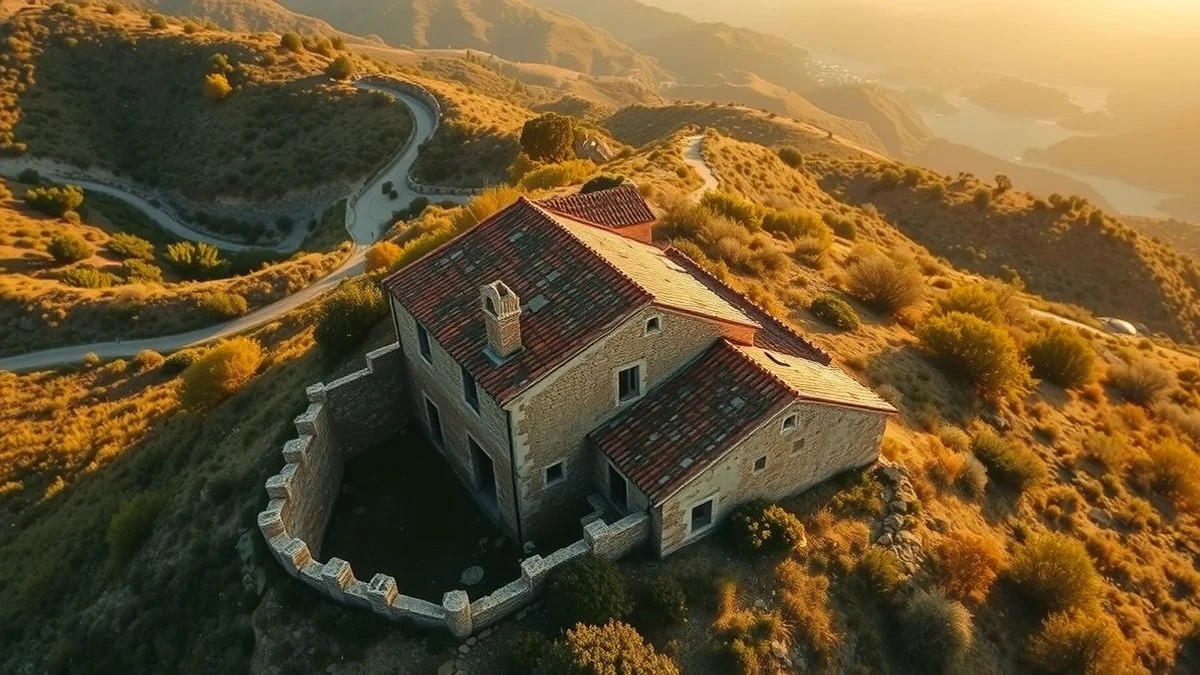
The municipal Plenary will give final approval to the project to rehabilitate an old farmhouse in Cerro Molina, in the Montes de Málaga, and convert it into rural accommodation with activities linked to the natural environment.
The Urban Planning Commission and the Plenary of Málaga City Council approved this Monday the project to recover a ruined farmhouse in the area of Cerro Molina, in the eastern part of the Montes de Málaga. The initiative, promoted by the company Valenciana de Promociones Urbanísticas 2000 SL, will transform the traditional building into a rural tourism establishment with complementary activities.
The affected estate has an area of 155,804 square meters and is classified as non-urbanizable land of special protection. The project does not contemplate building a new complex, but rather rehabilitating the existing farmhouse, currently in a dilapidated state, to give it a new use as rural accommodation and a centre for activities linked to the natural environment.
A long administrative process
The file was initiated in 2023 and has completed all administrative procedures, including public information, municipal technical reports, and the favourable pronouncement of the Junta de Andalucía. Málaga City Council highlights that the main value of the action lies in the recovery of a traditional construction that retains some of its original elements.
According to the municipal technical report, the intervention contributes to the conservation and enhancement of rural heritage, one of the arguments that justify the public and social interest necessary to authorize an extraordinary tourist use in rustic land. The project proposes a respectful rehabilitation, with architecture adapted to the slope of the land and avoiding large earth movements.
Activities and environmental conditions
The future establishment will offer accommodation and activities such as excursions in the natural environment, cycling routes, agricultural and hunting activities, and experiences linked to the landscape. The City Council emphasizes that the location responds to the very nature of rural tourism, which requires an environment away from urban centres, and that the prior existence of the farmhouse facilitates its landscape integration.
The authorization is conditioned on several obligations for the promoter. Among them, the registration of the entire estate to the authorized use, to prevent future subdivisions. In addition, a compensatory payment of 10% of the material execution budget of the works must be paid, and the urban planning license must be requested within a maximum period of one year.
The project incorporates environmental measures such as the installation of wastewater treatment systems for reuse in irrigation, the possibility of rainwater collection, energy solutions through aerothermal systems and possible solar installations, as well as landscape integration measures. The action must also pass the corresponding environmental procedures before its execution.
Next steps and deadlines
The Urban Planning Commission will elevate the proposal to the Plenary, which is competent to definitively approve this type of extraordinary actions on rustic land. Once approved, the agreement will be published in the Official Bulletin of the Province (BOP) and on the municipal website. The promoter will have one year to apply for the urban planning license in accordance with the approved project.
If the activity ceases to be developed for more than five consecutive years, the authorization could lose its validity, and the City Council could require the restoration of the land to its original state. For the residents of the capital, this project represents a new option for rural tourism just a few kilometres from the city, in the heart of the natural area of the Montes de Málaga.

You may also like