The Municipal Archive of Alhaurín de la Torre rescues documents from 1939 to 1960 that show how donkeys were the economic engine and also the subject of complaints about poor parking, escapes, and nocturnal scandals.
Before asphalt and engines dominated Alhaurín de la Torre, the streets were filled with hooves and long ears. A look at the documents from the Municipal Archive, ranging from 1939 to the 1960s, reveals that donkeys and mules were the true economic engine of the municipality: they transported harvests, pulled carts, and facilitated daily life. But where there is traffic, there are also recklessnesses, and the Civil Guard already had work to do back then.
On December 1, 1939, an edict from Mayor Cristóbal Ortega Navarro required all residents to submit a sworn declaration of their vehicles and animals within a month. The official list included trucks, cars, motorcycles, and bicycles alongside horses, mules, donkeys, and oxen. It was a snapshot of the vehicle fleet of the time, where four-legged animals were in the majority.
Love Affairs on Calle Real
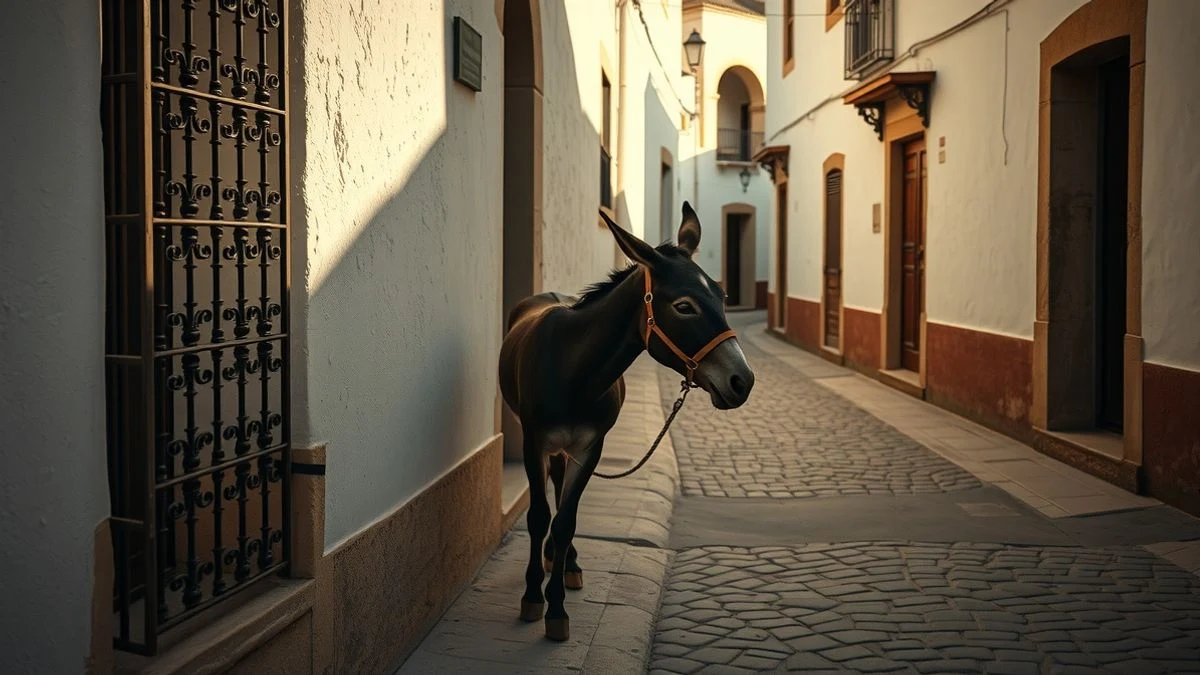
On April 18, 1960, at 11:45 PM, Francisco, nicknamed 'El Polo', was returning from work along General Franco Street, now Calle Real. As he passed by a window, he saw a female donkey, and his uncastrated donkey did not hesitate: it got nervous, and the owner tied it to the window grille. The Civil Guard sergeant drafted the report with all seriousness: "The individual Francisco V. G., (a) 'El Polo', was caught tying an entire donkey to a window grille, blocking the passage and creating a consequent spectacle, since there was a female donkey nearby."
The result was a complaint for violating the Urban Police Regulations. The anecdote shows that 'losing one's head' over love is not exclusive to humans, and that even then the Civil Guard had to mediate in jealousy matters, even if they were four-legged.
Poor Parking at the School Gate
On November 25, 1953, the Civil Guard reported Cristóbal L. C., a resident of the village of Santa Amalia, for having an unsanitary habit for the school community. According to the report, "he possesses a minor equine of the donkey species that he constantly keeps tied near the entrance of the Official School of that village, posing a danger to minors, in addition to producing foul odours at the aforementioned centre."
It was the equivalent of double parking at the school gate at pick-up time, but with a much more evident aroma. The document reflects that even then, the authorities were looking out for the safety and well-being of schoolchildren, even if the problem was a donkey tied next to the entrance.
Donkeys on the Run
Donkeys also escaped or got lost. In April 1952, Julián H. R. found an abandoned donkey on the road to Cártama. The document from the Civil Guard includes a detailed description of the animal, what would today be the technical sheet of a vehicle: donkey species, Spanish breed, apparently 17 years old, height 1.30 meters, dark grey coat, and particular marks: "Accidental injuries on the ribs, from work. Scar on the left hindquarter." This technical sheet is an example of how livestock was monitored back then, with a level of detail that today is dedicated to cars.
The escape of a donkey was not a simple loss: it was the loss of an essential work tool for the family economy. Therefore, the Civil Guard took the trouble to record every detail of the animal to be able to return it to its owner.
Stallion Services in Coín
To keep the 'fleet' in shape, the Stallion Depot of Coín sent an official letter on March 5, 1953, informing of the establishment of an Official Stallion Stop. It offered two Spanish horses, one Arabian, and, notably, "an excellent stallion (donkey) of Catalan breed." The service hours for mares and jennies of the local farmers were strictly regulated: from 10 to 11 and from 16 to 17 hours, every working day. A public service with a tight schedule that guaranteed the improvement of livestock breeds.
These documents, which the councillor for Historical Heritage, José Manuel de Molina Bautista, has made known, are a window into a not-so-distant past. Between the charming anecdote and the donkey love triangle, they reflect the fundamental role that animals played in the social, agricultural, and economic life of Alhaurín de la Torre. This summer, if parking is hard to find or you suffer a traffic jam, it’s worth remembering that at least the car doesn’t fall in love with the neighbour's façade or leave foul smells at the school gate.
Those interested in delving deeper can consult the funds of the Municipal Archive, in the Historical Fund and Correspondence section, where these and other documents narrate the evolution of the municipality. A way to learn about local history through its small great episodes.

You may also like