A team from the University of Cádiz has used ground-penetrating radar in the municipal cemetery to locate a suspected mass grave holding 34 victims of Francoist repression.
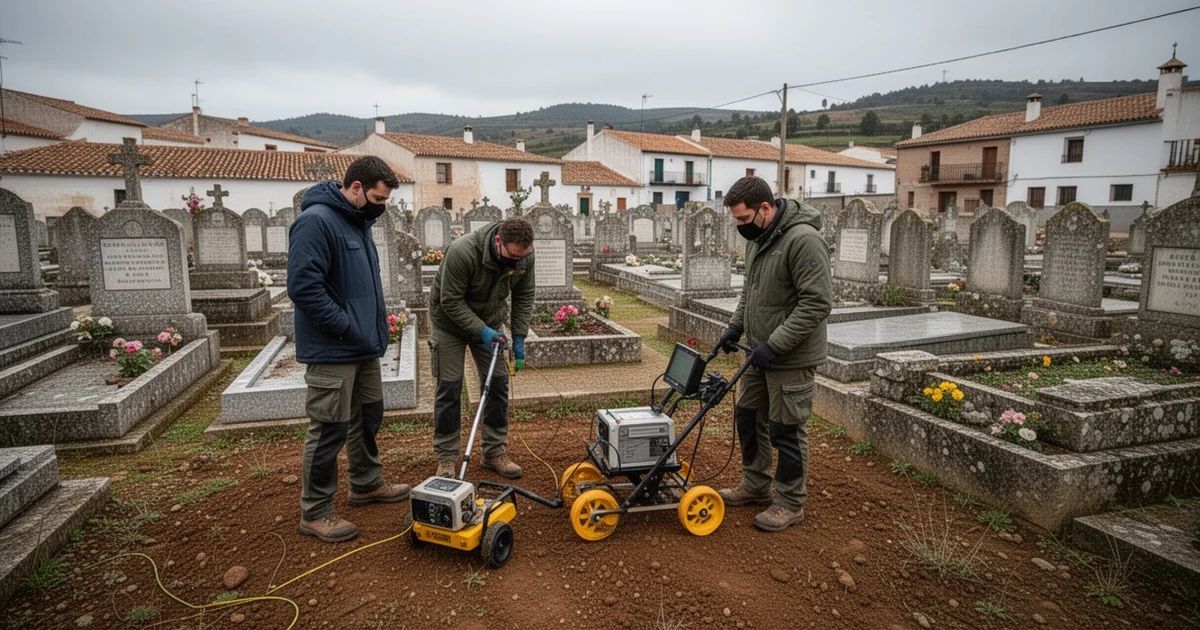
The search for a mass grave in the municipality of Cortes de la Frontera has officially begun. On Wednesday, June 10, researchers from the Department of Prehistory, History, and Philosophy at the University of Cádiz conducted a georadar survey in the local cemetery to pinpoint the suspected burial site.
According to the Ateneo A Galopar and the Grupo Memorialista de Cortes de la Frontera, the grave is believed to contain the remains of 34 residents—including four women—who were executed after the 1936 military coup. The location of the grave is based on a map of mass graves drawn up by the Junta de Andalucía in 2005, later updated by various memorial organizations.
“The investigations carried out by the ateneo and the memorial association have identified the names and surnames of 34 people shot in this municipality from 1936 onwards,” the groups stated. They added that in a town with a population of 6,300 at the time, a total of 159 residents were killed by Francoist repression, 85 of whom had some form of legal proceedings and 74 were killed without any police or judicial investigation between July 1936 and March 1937.
The georadar used by the university team scans the subsurface for anomalies that may indicate the presence of human remains or artifacts such as bullets. If the data shows positive results, archaeological test pits will be dug in the coming months to verify the findings. If remains are found, they will be exhumed and DNA testing will be used to identify the victims.
Similar searches have been carried out in other Andalusian towns, such as the recovery of 113 victims from mass graves in the province of Málaga in 2022. The work in Cortes de la Frontera is part of a broader effort to locate and identify victims of the Franco dictatorship, supported by the regional government's map of forced disappearances.
The memorial groups emphasized that the search is not only about recovering remains but also about restoring dignity to the victims and their families. “We owe it to those who were silenced,” said a spokesperson. The next steps will depend on the analysis of the georadar data, which is expected to be completed within weeks. If confirmed, archaeological excavations could begin by autumn, with the aim of finally giving a proper burial to those who were executed without trial.
You may also like