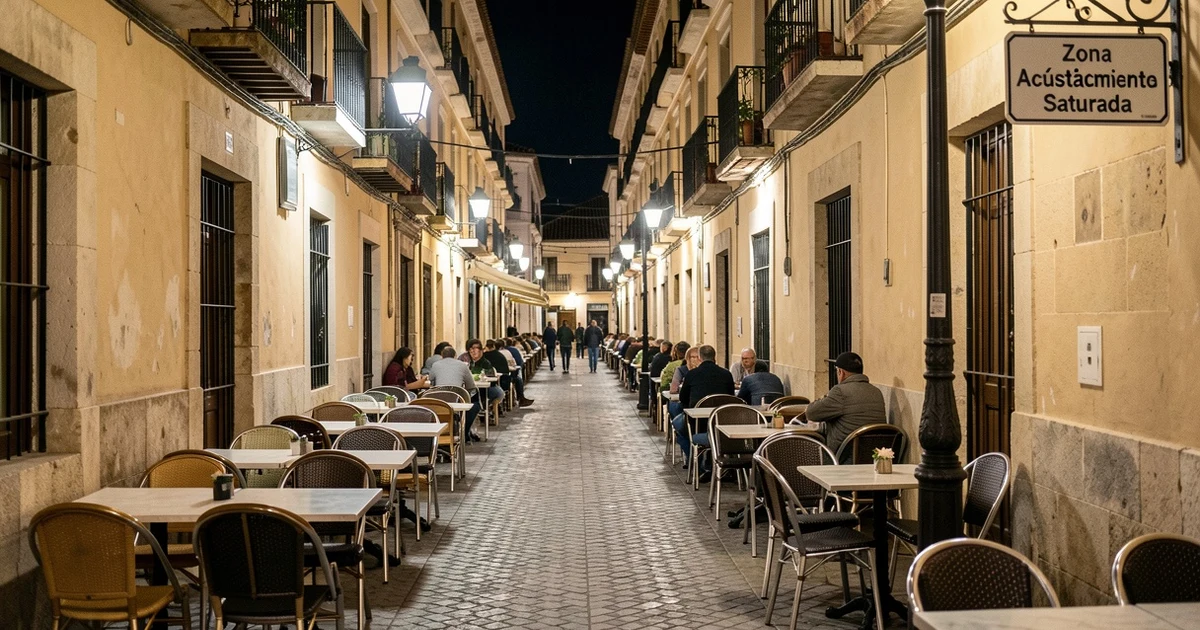
The Centro Antiguo Residents' Association of Málaga has expressed its strong rejection of the municipal statement claiming a 92.5% reduction in noise in the Acoustically Saturated Areas. Residents describe the conclusions as implausible and denounce a lack of transparency.
The Centro Antiguo Residents' Association has heavily criticized the Environment Department of the City Council, accusing it of "whitewashing" the noise problem in the historic centre. In a statement released this Friday, residents assert that the reality they experience every day and night is far from the official data.
The conflict erupted after the City Council released a report from the monitoring table of the Acoustically Saturated Areas (ZAS), held on June 29, which claims that noise levels have been reduced by up to 92.5%. A figure that residents label as "completely implausible."
A 92.5% reduction that residents do not notice
According to the association, this conclusion "is based on data that is publicly unknown" and which they have been requesting unsuccessfully for some time. "It is a misleading message that conveys the idea that noise has practically disappeared from our lives thanks to municipal action," they lament.
Residents recall that since the first acoustic measurements of the ZAS in 2015 and 2016, the pressure from tourism, the concentration of terraces, nightlife, and bachelor parties has increased "considerably and evidently." Therefore, they consider it "especially serious" that the Environment Department insists on "a complacent narrative."
The current regulations establish that the Administration must carry out new periodic measurements at the same points and using the same procedure, and make that documentation publicly available. Residents claim they have no evidence that this has been fulfilled and have "serious founded doubts about its correct application."
Lack of transparency and concealment of reports
The association also questions the transparency of the City Council, accusing it of "hiding detailed acoustic measurements, not informing about the specific methodology applied, and preventing residents from verifying the accuracy of the conclusions."
For residents of the Historic Centre, this situation is not new. They have been denouncing for years that nighttime noise, especially on weekends, makes rest nearly impossible. Many have opted to install double windows or move to other areas. "You can't live here," some affected individuals assert.
The City Council, for its part, defends its management and claims that the data is reliable. However, residents demand that the original technical reports be published for verification. Meanwhile, discontent grows.
The association has announced that it will bring the matter to the next Environment Committee and does not rule out mobilisations if they do not receive answers. Noise in Central Málaga, a historic problem, is back at the centre of the debate.

You may also like