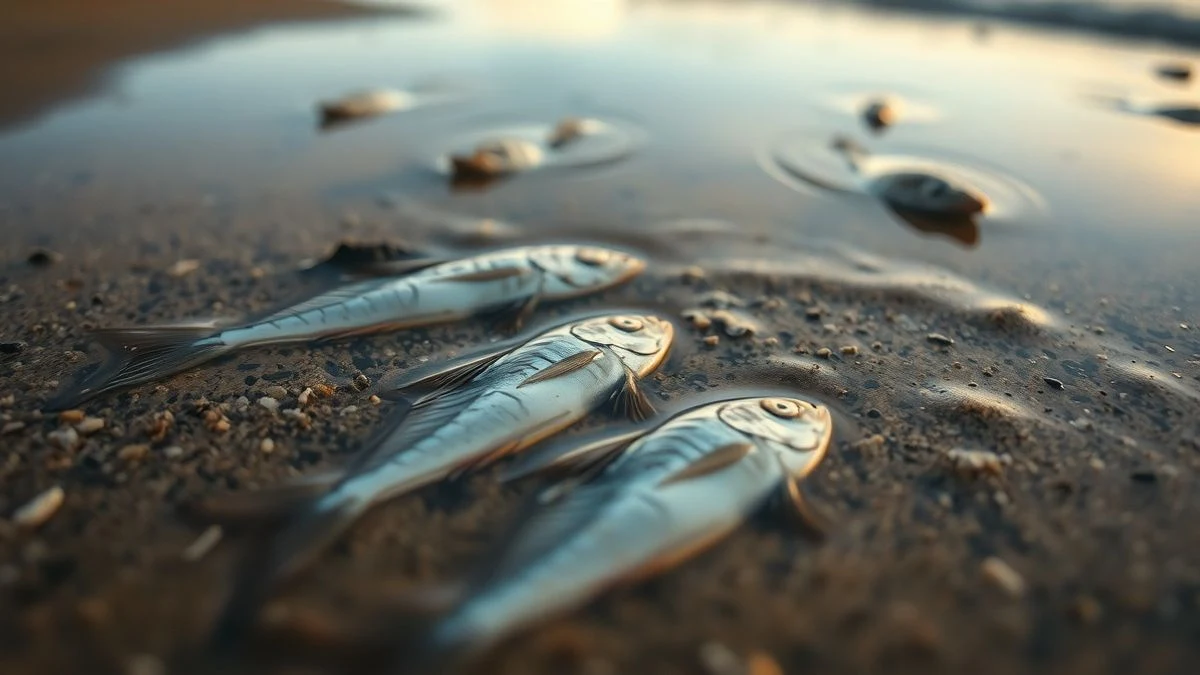
Hundreds of fish have been found dead at the mouth of the Guadaiza River in Marbella. The council points to asphyxiation due to rising tides, while Ecologistas Malaka attributes it to the artificial closure of the mouth.
The Guadaiza River, classified as a Special Conservation Area (ZEC) and part of the Natura 2000 Network, has been the scene of a massive fish mortality event that has left authorities and ecologists on edge. Since last Tuesday, municipal workers have been removing the carcasses of hundreds of specimens, mainly mullets, barbs, and eels, that have been found floating at the mouth of the river within the municipality of Marbella.
The Marbella City Council, which invested over 2.6 million euros last year in the renaturalisation of the area, has launched an investigation to clarify the causes. Initial analyses suggest that the fish may have died from asphyxiation after becoming trapped in a freshwater lagoon following a tide rise. “During a tide rise, a school of fish could have entered the area and, when trapped as the tide receded, they would have died from lack of oxygen in the freshwater,” municipal sources explain.
However, the council does not rule out other hypotheses, such as a possible spill. “Water analyses are already being conducted, both by Hidralia and Health,” the same sources assure. As a preventive measure, heavy machinery has been used to widen the mouth of the river, reshape the area, and carry out sand movements to “promote water renewal and circulation and minimise any potential risk in the event that a spill is confirmed.”
For its part, the Junta de Andalucía, responsible for maintaining the natural conditions of the riverbed, agrees with the hypothesis of natural asphyxiation. “The entry of specimens due to the tide creates a lagoon where they run out of oxygen,” officials from the Andalusian Administration indicate.
However, the Ecologistas Malaka group offers a very different version. According to them, the mortality is due to the “closure” of the river mouth by the City Council's Beach Department for “aesthetic reasons.” “The council has this criterion for beach profiling and ends up closing all the outlets of these riverbeds to the sea with machinery, which prevents many fish from escaping and they end up asphyxiating,” the group claims.
The ecologists add that the council “should maintain a water line,” and criticise that the closure of the mouth “is done daily.” “If there is unpleasant water, it ends up being closed so that the beach is continuous and people do not have the inconvenience of having to cross the river,” they lament, emphasising that the management of this area at the end of the riverbed “should be somewhat different.”
Additionally, Ecologistas Malaka points out that “there is no ecological flow of the river,” as a golf course in the area has had irrigation rights from the irrigators for years and “completely diverts the flow” to the golf facilities. They also report that there are “frequent spills of sewage” in the Cortijo Blanco area.
The council, for its part, vehemently denies that the mouth is closed for aesthetic reasons. “The causes of the loss of fauna are being studied,” they insist, and remind that the renaturalisation of the Guadaiza River, completed last year, included the maintenance of fauna and flora. Meanwhile, the removed fish have been transported by health services to an authorised facility for incineration, pending the results of analyses to determine whether or not there was a spill.
This incident has generated great concern among Marbella residents, who see one of the municipality's most emblematic natural spaces suffering a serious episode of pollution or, at the very least, poor management. Local and regional authorities have promised transparency in the investigation, while ecologists demand measures be taken to prevent a similar situation from recurring.

You may also like