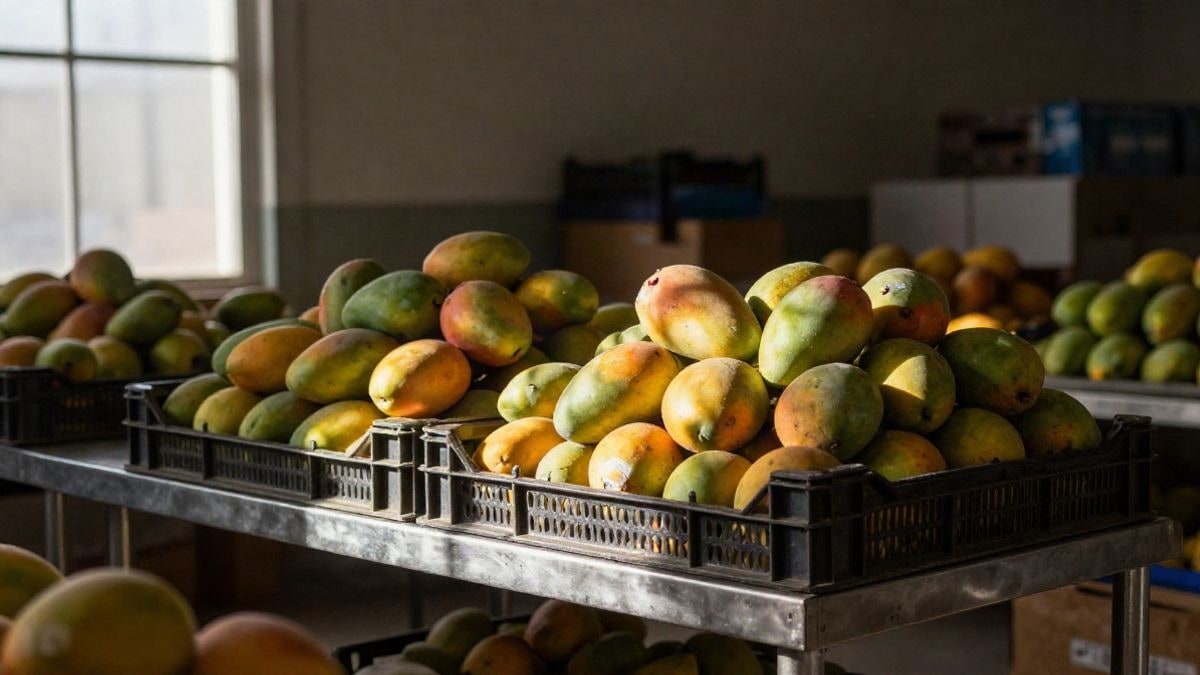
The Junta de Andalucía estimates a production of 40,000 tonnes of mango in the province of Málaga and a value of €60 million for farmers. The campaign enters its peak weeks in Axarquía with a 30% decrease compared to 2025.
The mango campaign faces its busiest weeks in the Axarquía with a forecast of 40,000 tonnes in the province of Málaga and an approximate value of €60 million for farmers. These are the estimates provided by the Junta de Andalucía, as reported by Diario Sur, and presented by the territorial delegate for Agriculture, Fisheries, Water and Rural Development, Laura Soto, during a visit to the central facilities of Trops in Vélez-Málaga this Tuesday.
Soto toured the cooperative accompanied by the mayor of Vélez-Málaga, Jesús Lupiáñez (PP), during one of the busiest moments of the harvest. The regional official positioned Trops as the main marketer of subtropical products in Spain, holding 55% of the mango market share and 40% of the avocado market share.
The forecast represents a decline of around 30% compared to the previous year, a decrease that the delegate downplays due to the reference point. "We must remember that the comparison is made against the 2025 campaign, which recorded record figures for mango, with a total of 60,000 tonnes produced," Soto noted.
This comparison should be read with caution because the sector itself handles different figures. At the beginning of September, the Asociación Española de Tropicales (AET) estimated the current harvest at around 40,000 tonnes, after raising an initial estimate of 30,000, and also used about 40,000 tonnes as a reference for the previous campaign.
Beyond the volume, administrations, farmers and marketers agree on highlighting quality as the key to the season. The AET has already pointed out that mangoes are entering the market this year with "exceptional quality," while sector organizations have insisted throughout the summer on avoiding premature harvesting that could deteriorate consumer experience and harm the image of Spanish products.
The province maintains an almost hegemonic position in Andalusian cultivation. Málaga exceeds 13,000 hectares of subtropical crops, with nearly 8,000 of avocado (54% of the Andalusian area) and over 4,500 of mango, equivalent to 90% of the regional total. The mango area has grown by 42% in the last decade.
Trops currently operates in 22 European markets, including the United Kingdom, Germany, and the Netherlands, and controls the process from cultivation and harvesting to packaging and distribution. Soto described the entity as an example of "more profitable, competitive, and sustainable" agriculture and highlighted its technological commitment.
During the visit, the delegate learned about the Trops Innovation Centre, an experimental farm where the cooperative researches alongside the University of Málaga and the Institute of Subtropical and Mediterranean Horticulture La Mayora, under the CSIC. Among its lines of work are new varieties, sensor technology, application of artificial intelligence to irrigation, and development of resistant rootstocks.
Water remains the structural constraint of the sector despite the rainfall recovery in recent months. The Junta estimates €43 million in investments from the first drought decrees to expand the use of reclaimed water in Axarquía, with actions in the treatment plants of Vélez-Málaga, Torrox, Algarrobo, Rincón de la Victoria, and Peñón del Cuervo, and their connection to irrigable areas.
These works are supplemented by aid for the damages caused by storms at the end of 2025 and the beginning of this year: €4.44 million granted to 200 Málaga farms, with another 69 cases under review that could raise the total to €7 million.
With September and October as decisive months for marketing, the sector's challenge is to sell a larger quantity of fruit without losing quality or pressuring prices, reinforcing the identification of Spanish mango as a local and seasonal product.

You may also like