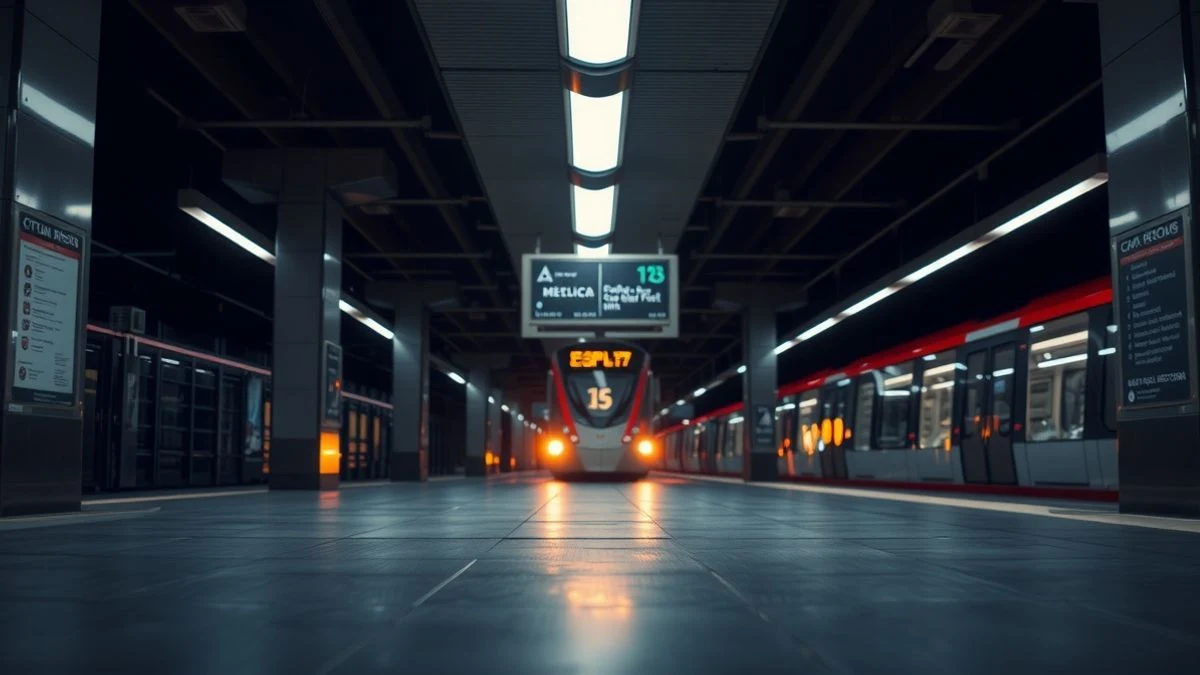
The Málaga underground achieved a net profit of €49.1 million in 2025, a new record, and has accumulated over €356 million since it began operations. 76% of the shares are held by French funds.
The Málaga Metro continues to be a lucrative business for its shareholders. The annual accounts of the concessionary company, Metro de Málaga S. A., reveal that the 2025 financial year closed with a net profit of €49,132,196, nearly two million more than the previous year. This money has been fully distributed as dividends among the partners, according to the unanimous agreement adopted on June 12.
Since the underground began operating, the total profit amounts to €356.1 million, of which approximately €294 million has been distributed as dividends. The shareholding is dominated by French funds: VIM 1, VIM 2, and VIM, S.A.R.L. collectively control 76.31%, while the Public Works Agency of Andalusia, dependent on the Junta, holds the remaining 23.69%.
Record number of passengers and million-euro compensations
The increase in results is supported by two pillars. On one hand, demand: 2025 marked a new record with 19,222,912 passengers, consolidating the metro as a transport alternative in the capital. On the other, the so-called parameter A, a contractual clause that obliges the Junta de Andalucía to compensate private partners with tens of millions of euros annually for delays in the construction and commissioning of the infrastructure.
This parameter will remain in effect until the end of 2027, the date initially planned for the arrival of trains in the vicinity of the Civil Hospital, passing through the Guadalmedina station. However, the works are facing new delays, and all indications suggest that it will not be possible until 2030. The contract already includes an automatic extension of the transitional period if deadlines are not met.
A secured concession
The concession contract, signed between the Junta and the concessionaire, includes mechanisms that guarantee the profitability of the business. In addition to compensations for delays, the agreement allows profits to be fully distributed each year. In 2025, the €49.1 million was allocated to dividends, of which the Junta received about €11.6 million (its proportional share), while the French funds pocketed the rest.
The Málaga Metro began construction in mid-2006, and its launch was fraught with delays. Line 1 and Line 2 were inaugurated in 2014, but the complete layout is still unfinished. The extension towards the Civil Hospital, key to serving the northern part of the city, is expected to be completed in at least four years. Meanwhile, the underground continues to generate substantial profits for its owners, with the Andalusian taxpayer covering part of the bill through compensations.
“It is a business model in which the demand risk is borne by the Administration, while the private investor is guaranteed a return,” industry sources point out.
For the Málaga user, the metro remains a public service, but its operation is predominantly in foreign hands. The Junta defends that the concession model allowed the construction of the infrastructure at no initial cost to public coffers, although in the long term, compensations and dividends represent a multi-million euro outlay.
With the record number of passengers in 2025, the trend is positive, but the figure is still below the threshold of 20 million annual passengers estimated necessary for financial balance without subsidies. Meanwhile, the business machinery continues to operate: over €356 million in accumulated profits, and rising.

You may also like