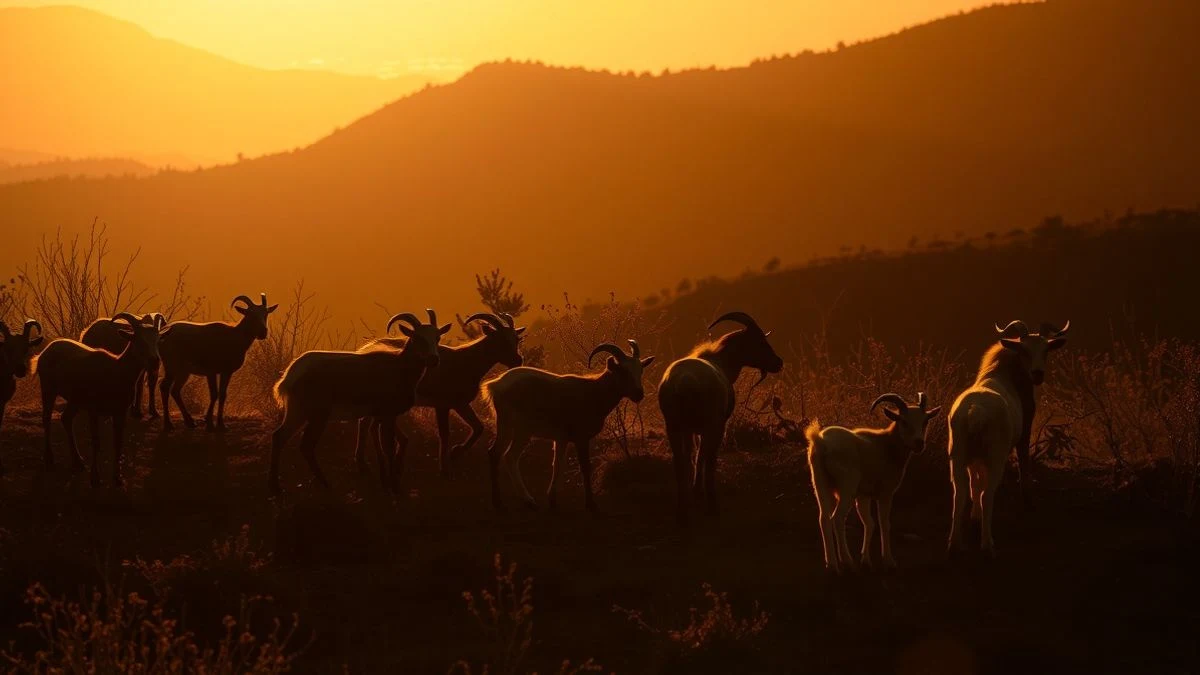
The Coordinator of Agricultural and Livestock Organisations (COAG) promotes the use of goat herds as biological firebreaks in Axarquía due to the high risk of forest fires.
The Axarquía region of Málaga, one of the areas most affected by forest fires in the province, is once again putting a traditional solution on the table: 'firefighting goats'. The Coordinator of Agricultural and Livestock Organisations (COAG) has proposed to revive extensive livestock farming as a tool to clean the land and create natural firebreaks, in light of the accumulation of dry biomass that turns the landscape into a powder keg.
The initiative has gained momentum following the fire that recently devastated around 10,000 subtropical trees in municipalities such as Árchez and Cómpeta, which forced the preventive evacuation of more than 160 people. Furthermore, the tragedy of the Los Gallardos fire (Almería), where 13 people lost their lives, has put the entire community on alert.
According to COAG, goat herds, guided by local shepherds familiar with the terrain, can alleviate the excess vegetation cover in mountainous areas and extensive agricultural operations. These animals feed on underbrush and reduce the continuity of combustible vegetation, thereby hindering the spread of flames.
The agricultural union warns that the decline of traditional livestock farming has allowed scrubland to colonise critical areas. The lack of extensive livestock use has increased the accumulation of fine and dry biomass in undergrowth, creating an ideal scenario for large fires.
The urgency of implementing these measures has been exacerbated by weather conditions. The State Meteorological Agency (Aemet) has issued special warnings indicating that fire danger indices are at historic highs in the province. The arrival of warm air masses from North Africa, combined with the possibility of dry evening storms, places the Málaga coastline and inland areas under a severe thermal blocking pattern.
COAG raised the alarm just hours before the fire in Axarquía, warning about the enormous accumulation of biomass in the mountains. The organisation calls for structural initiatives to recover extensive livestock farming as a preventive tool, and not just as a one-off measure.
Farmers in the region recall that historically their herds kept the fields clean and passable. However, the abandonment of forested areas and lack of support for the sector have caused scrubland to spread uncontrollably. Now, they propose that agreements be established with administrations so that shepherds can access high-risk areas and carry out natural clearing work.
The proposal for 'firefighting goats' is not new, but the severity of the current situation has made it an urgent necessity. Axarquía, with its rugged topography and subtropical vegetation, is particularly vulnerable. Recent fires have demonstrated that conventional methods are insufficient and that complementary solutions are required.
COAG insists that extensive livestock farming not only helps prevent fires but also contributes to maintaining biodiversity and stabilising rural populations. Therefore, they urge administrations to invest in this sustainable tool and to implement it structurally in fire prevention plans.
Meanwhile, farmers in Axarquía hope that their herds can return to graze in the mountains, not only as an economic sustenance but as a shield against fire. The upcoming high-risk season will be crucial to see if this proposal becomes a reality.
You may also like