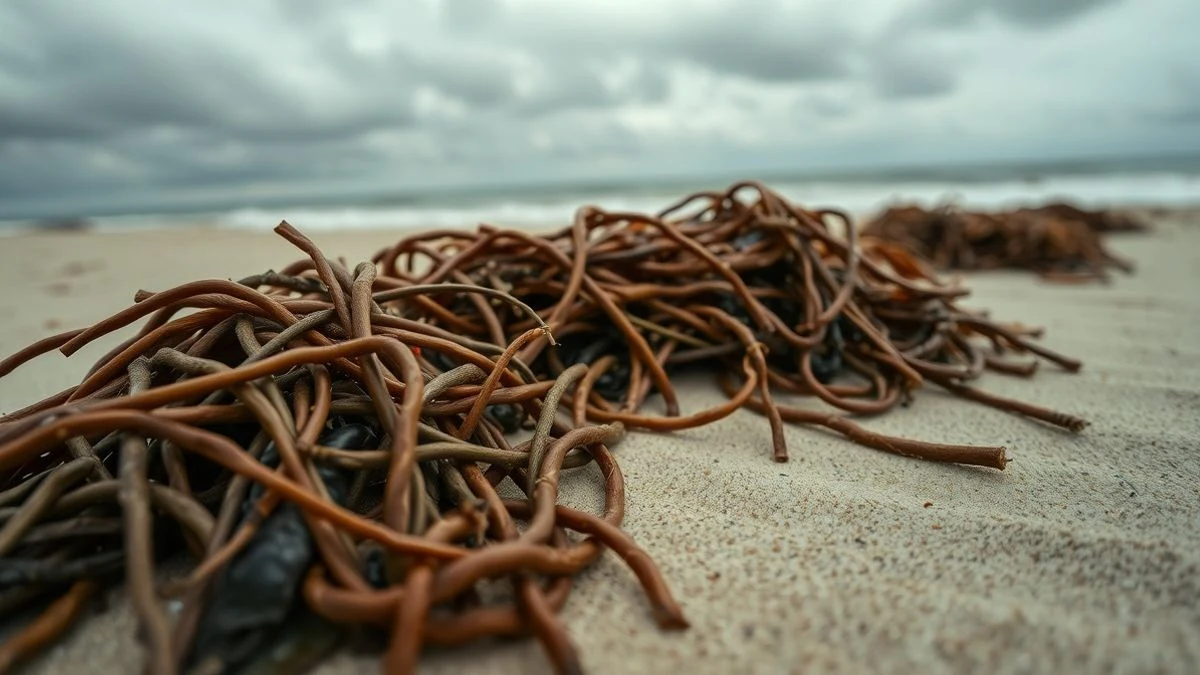
The Costa del Sol Occidental has removed over 15,000 tonnes of Rugulopterix Okamurae in 2026. Marbella is the most affected municipality, with 10,000 tonnes and a cost of over one million euros.
The Asian algae plague Rugulopterix Okamurae continues to hit the Malaga coastline, with record collection figures in the municipalities of the Costa del Sol Occidental. So far in 2026, the town halls of Estepona, Marbella, Mijas, and Casares have collectively removed over 15,000 tonnes of this invasive species, according to data provided by the municipalities themselves.
Marbella, with its 27 kilometres of coastline, is the municipality that has suffered the most from the massive arrival of algae. Between January and July of this year, the Town Hall has collected over 10,000 tonnes, a figure that doubles the 5,300 tonnes removed in the same period of 2025. The cost of these efforts has exceeded one million euros, according to municipal sources.
The presence of this algae in Marbella has been increasing since its first detection in 2020, when 750 tonnes were removed. Since then, the quantities have risen: 900 tonnes in 2021, 350 in 2022, 700 in 2023, 2,000 in 2024, and 5,300 in 2025.
In Estepona, the situation is also critical. The Town Hall has removed 3,230 tonnes so far this year, a figure that adds to the historical record of 9,670 tonnes collected throughout 2024. Last June, the municipality activated an urgent emergency plan after recording 1,100 tonnes in just five days on La Rada beach. The annual cost for the Estepona Town Hall exceeds one million euros.
Mijas, for its part, has removed over 1,600 tonnes of Asian algae in 2026, a quantity that far exceeds the 600 tonnes collected between June and August last year. The Town Hall has allocated over 1.5 million euros since 2024 to address this environmental emergency.
Casares has collected 440 tonnes between June 26 and 30, while last summer it removed over 600 tonnes in the same summer period.
The director of the Coastal Sciences Chair at the University of Malaga (UMA), Francisco Franco, explained that the increase in the arrival of algae is due to the colonisation of new rocks on the Costa del Sol and the effect of ocean currents. According to the expert, a large part of the influx comes from the Gulf of Cádiz, where the algae grow and are transported by Atlantic currents entering through the Strait of Gibraltar.
“Large masses of Rugulopterix Okamurae debris form, getting tangled and creating mats that are carried along the seabed by the currents,” Franco detailed. The scientist noted that the situation has worsened this year, with a more intense and frequent arrival at the Malaga beaches.
The expert explained that there is a dual entry route: with easterly winds, the algae that grow near the shore arrive, and with westerly winds, those accumulated on the seabed. “Depending on the currents, they are brought closer to the beaches of Marbella, Estepona, Mijas, or Benalmádena,” he indicated, adding that large quantities are also reaching the Malaga capital.
The Rugulopterix Okamurae is listed in the Spanish Catalogue of Invasive Alien Species of the Ministry for Ecological Transition and the Demographic Challenge. Its proliferation threatens marine ecosystems and poses a serious problem for tourism and the local economy, as it forces town halls to allocate significant resources to beach cleaning.
Residents and tourists of the Costa del Sol Occidental are the most affected, as the accumulation of algae on the shore generates unpleasant odours and hinders the use of the beaches. The town halls recommend not touching the debris and waiting for it to be removed by cleaning services.
The forecasts for the coming months are not optimistic. Experts warn that if weather and marine conditions remain the same, the arrivals of algae could continue to be high throughout the rest of the summer. The town halls have announced that they will maintain emergency plans and reinforce the machinery and personnel dedicated to removal.

You may also like