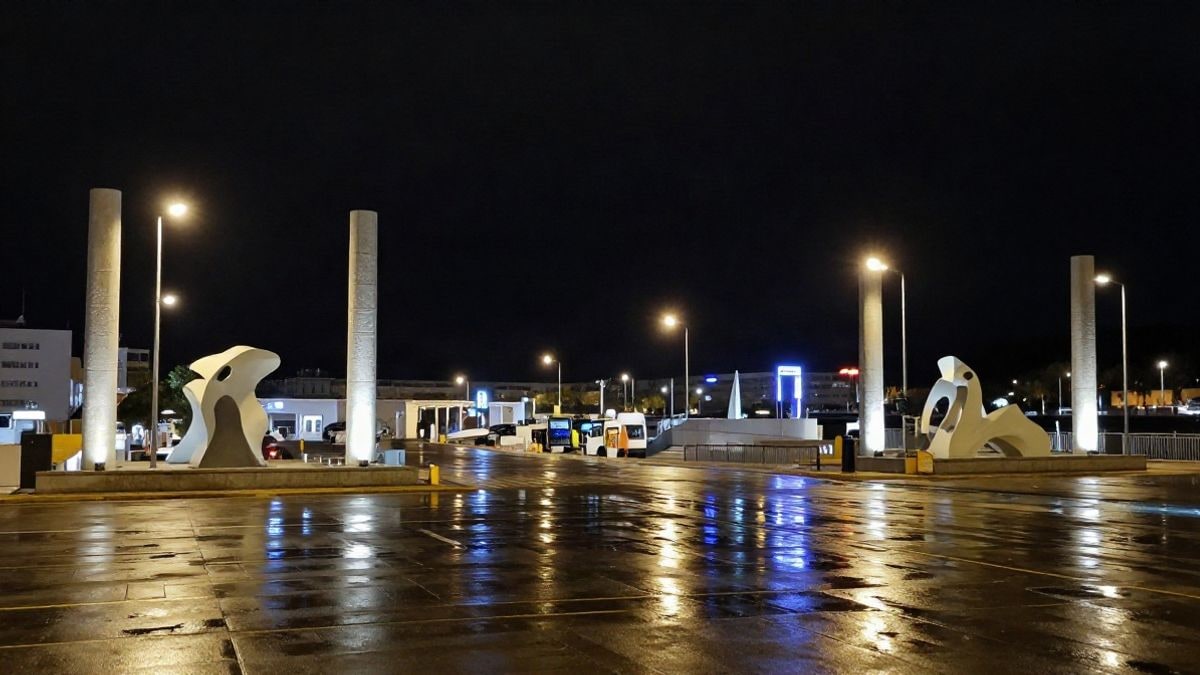
The Government Subdelegation in Málaga demands that the Port Authority clarify whether the permanence of the sculptures by Ginés Serrán at the Port is being processed in accordance with the law. The City Council transferred the works this month and requests to keep them for between six months and a year.
The Government Subdelegation in Málaga has requested explanations from the Port Authority regarding the procedure followed to maintain the sculptures of Ginés Serrán at the entrance of the Port of Málaga. In a letter signed this week, the subdelegate, Javier Salas, warns that, despite being part of the governing board of the body, he has not been informed of any file that authorizes their permanence, according to Diario Sur.
The letter demands clarification on whether the authorization requested by the City Council to preserve the sculptural group 'Las Columnas del Mar' is being processed "in accordance with the established legal channels." Salas states that he learned of the decision through the media and reminds that the authorization must go through the governing board of the Port Authority. To support this, he cites the organizational regulations of the body, which assigns the board the competence to "grant concessions and authorizations" related, among other issues, to the occupation of public port domain.
The change of ownership of the works is key. Until now, they belonged to Serrán and were at the Port thanks to a contract under which the artist transferred them free of charge to the Port Authority, but that agreement has now expired. The pieces are now owned by the City Council and, according to the Subdelegation, for them to remain in the same place a new authorization is necessary that must go through the governing board.
The Government's intervention comes after the City Council decided on September 15 to accept the unconditional free transfer of the set offered by Serrán. The local governing board then announced that it would request authorization from the Port Authority for the sculptures to remain in their current location for the time agreed upon by both institutions, initially between six months and a year. The City Council thus defends the temporary continuity of pieces that, after the artist's transfer, have become part of the municipal heritage.
The decision reopened the controversy that has accompanied 'Las Columnas del Mar' since its installation was known. The Royal Academy of Fine Arts of San Telmo, the Ateneo de Málaga, the Economic Society of Friends of the Country, and the Institute of Urban and Social Studies (IEUS) have repeatedly expressed their rejection of the set and its location at one of the main accesses to the Port. Their objections have not been limited to the artistic quality or the impact of the figures on the urban landscape: they have also questioned various aspects of the processing and demanded greater transparency.
In May, these institutions publicly denounced that, three months after requesting information from various administrations about the legality of the installation, its heritage impact, and the processing of the project, they had still not received an official response. They have also questioned the lack of citizen participation and the effect of the set on a sensitive area of the historic centre.
The controversy has already forced modifications to the original project. The installation was initially proposed for 25 years, but the Port Authority announced in January, in response to the cultural institutions' backlash, that it would limit the exhibition to six months and that, once that period was over, the works would be dismantled and moved to "a consensual location with less impact." That deadline has now passed, but the scenario is different: Serrán has definitively transferred the works to the city and the City Council wants them to remain, at least temporarily, where they are.
The Government's intervention now opens another front in a controversy that affects one of the main accesses to the Port of Málaga and which is expected to continue unfolding in the coming weeks.

You may also like