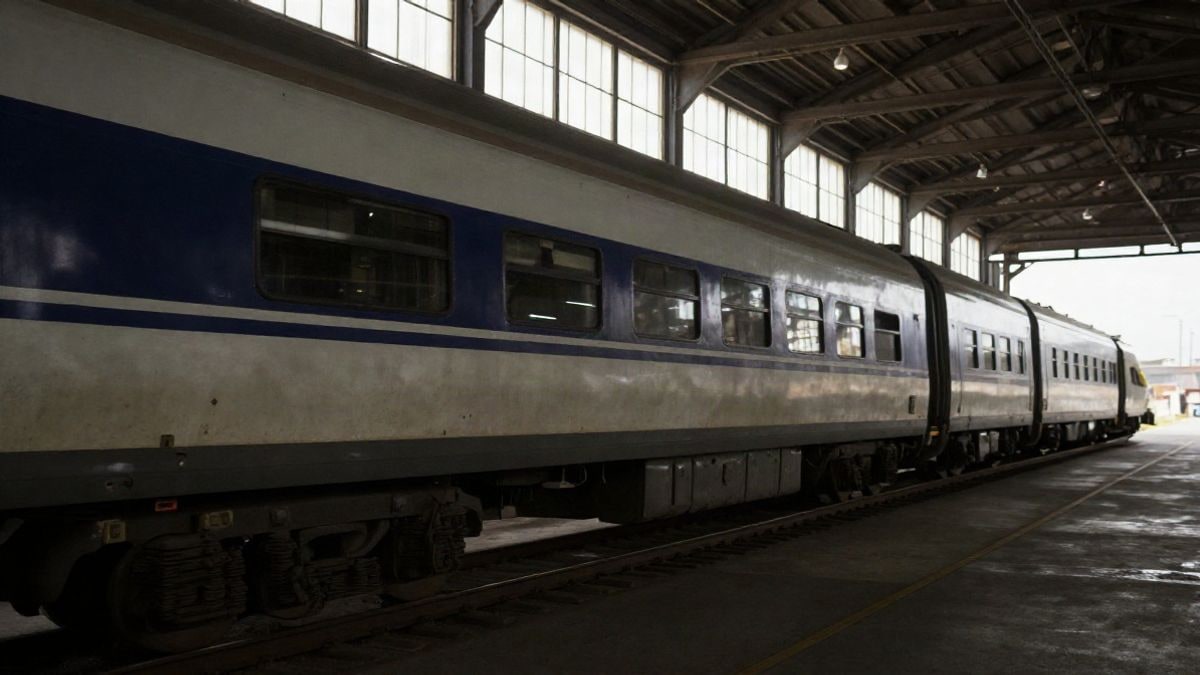
Renfe's maintenance centre in Los Prados, in Málaga, celebrates 19 years on December 23. The factory, covering 17,200 square metres, employs around 210 professionals and operates continuously 365 days a year.
The AVE workshop of Renfe in Los Prados, in Málaga, marks its 19th anniversary on December 23. The facility, spanning 17,200 square metres, employs around 210 professionals from various companies and maintains the trains that service the corridors from Málaga to Madrid, Sevilla, and Granada, as reported by Diario Sur.
The workshop occupies 1,200 square metres, has three tracks of 400 metres each, and six work positions. Its length of 430 metres allows for the simultaneous parking and maintenance of double units, each 200 metres long. A fourth track is dedicated to washing, where trains enter and exit, and in the buffer zone, there are four parking spots and one track for turning. The facility has its own treatment station to eliminate the wastewater extracted from the trains.
The workflow aims to mimic a Formula 1 pit stop: the goal is to minimise the immobilisation time of each unit. Around 60 employees from Talgo, 45 from Betren (a consortium involving Renfe, Bombardier, and Alstom), and 48 from the Renfe Engineering and Maintenance subsidiary work at the centre, along with auxiliary staff for manoeuvres, security, facility maintenance, and industrial cleaning.
José Antonio Otero Luzón, parts technician at the factory, has 46 years of service with the railway company. Born in Granada and adopted by Málaga, he began his career at 16 in the former Apprentice School, a precursor to the current dual vocational training. After 25 years in Madrid, he moved south with the arrival of the first high-speed trains. "We are open like petrol stations: 24/7, 365 days a year," explains Otero. The workshop organises work in three shifts, with more activity during the morning and night shifts, because "trains are making money on the tracks during the day, and the last one comes in between 23:30 and 00:30 at night."
Maintenance is governed by the mileage of each unit. "You can draw a parallel with cars, which have inspections based on mileage," Otero details. The first basic inspection occurs between 5,000 and 7,000 kilometres, and the guidelines repeat up to one million kilometres, with intervals of 25,000-30,000, 60,000, 75,000, 125,000, 250,000, and 500,000 kilometres. Units that pass through the workshop can accumulate up to six million kilometres, equivalent to about 150 laps around the Earth.
In Los Prados, three series are maintained: the 102 and the 112, popularly known as the "duck," which covers the Málaga to Madrid corridor, and the 104, which provides the Avant service from Málaga to Sevilla and Granada. The main contingent consists of 25 units from the 102 and 112 series, and another five from the 104. The workshop is multi-series, so others like the 103 and 106 can enter, although it is specialised in the first three due to homologations and materials.
The process begins with automated exterior washing, complemented by manual cleaning when trains arrive very dirty. After that, wastewater is extracted, and the interior is cleaned according to each unit's maintenance plan. The toilets are a critical point. The sanitation system uses a biocidal liquid that breaks down organic matter, but workers find debris that causes blockages and unpleasant odours. "We have the same problem here as in all treatment plants, which is the wipes. We encounter many comfort issues due to bad smells or closed toilets because people even throw packs of cigarettes and cans, causing blockages," Otero points out. When a unit suffers a serious incident of this type, it can be brought to the workshop, the waste extracted in just half an hour, and then return to service.
Another common situation is the collision with birds and larger animals like wild boars and rabbits, for which there is a protocol for the removal of organic matter with prior sanitation and protections for the workers. Trains are also repaired for bodywork and painting: at the entrance of the factory, a new front end ready for installation can be seen. The time spent in the workshop varies depending on the level of intervention; a basic inspection requires between 8 and 12 hours.
The open day on September 19 filled its quota of 250 visitors in less than 48 hours and brought together workers, retirees with their families, and railway enthusiasts. The workshop, one of the largest maintenance centres for Renfe at the national level, was initiated by the then Minister of Development, Magdalena Álvarez.

You may also like